



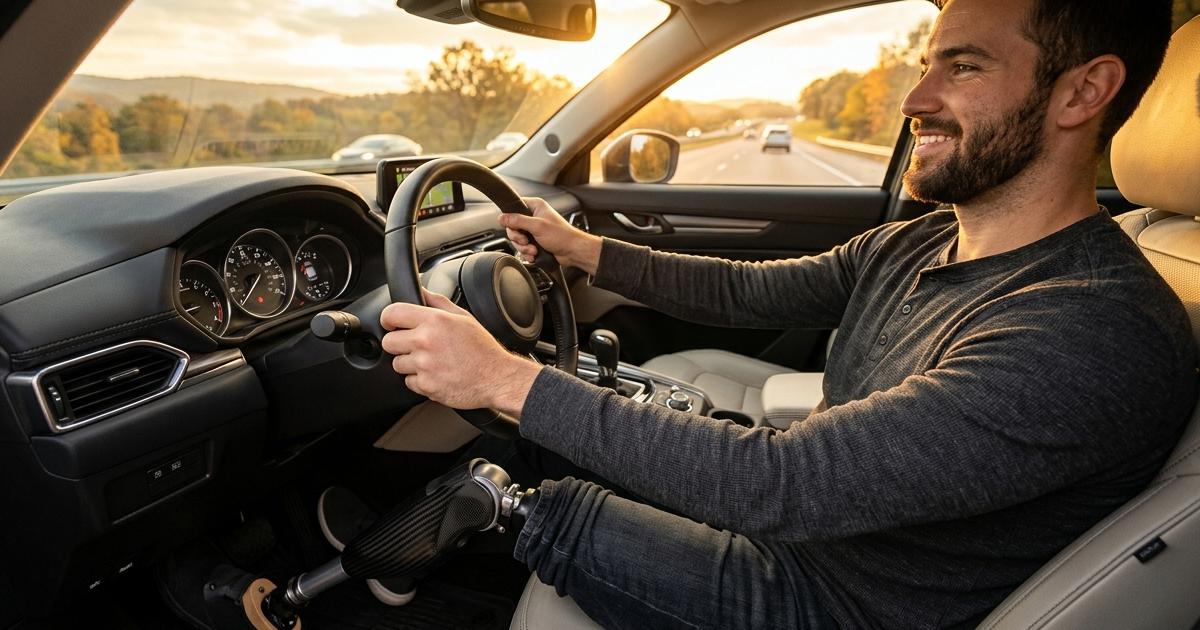

There is a moment that every amputee who drives remembers. It is that first time you slide into the driver's seat, look down at your prosthetic foot on the pedal, and wonder — can I actually do this? For me, that moment came about four months after my amputation. I had been a driver my whole life. I drove trucks, hauled gear, made long road trips with Dede. The idea of not being able to drive felt like losing one more piece of who I was.
I am happy to tell you that I drive every single day now, and honestly, it became one of the biggest confidence restorers in my recovery. Getting back behind the wheel gave me back my independence in a way that almost nothing else did. But it did not happen without questions, some trial and error, and a few important conversations with my prosthetist and my doctor. So let me walk you through what I learned, what helped, and what every below-knee amputee should know about getting back on the road.
The First Question: Is It Legal for You to Drive?
Before anything else, this is the question you need to answer. The rules vary depending on your state, which limb was amputated, and what type of prosthetic or adaptive equipment you use. In Florida, as a right-leg below-the-knee amputee, I was required to check with my doctor and, in some cases, a certified driver rehabilitation specialist before returning to driving without restrictions.
Here is what I recommend doing right away:
- Talk to your physician and get medical clearance before you attempt to drive again.
- Contact your state DMV to ask about any requirements for amputee drivers in your area.
- Ask for a referral to a Certified Driver Rehabilitation Specialist (CDRS). These professionals are trained specifically to evaluate and assist people with physical disabilities in returning to driving safely.
- Check your car insurance policy. Some insurers want to know about adaptive equipment or physical changes that may affect driving.
- If you are a veteran, the VA can sometimes provide driver rehabilitation services and even help with vehicle modifications.
I know it can feel like a lot of red tape, but clearing these hurdles early protects you legally and gives you the confidence of knowing you are truly safe to be out on the road.
Right Side vs. Left Side Amputation: It Really Does Matter
A lot of new amputees ask me whether being a right-leg amputee is more complicated for driving than being a left-leg amputee. Honestly, the answer is yes — and here is why.
Right-Leg Amputees
If you lost your right leg, you are dealing with the side that typically controls both the gas and the brake in a standard vehicle. This means there is more to relearn and more to consider when it comes to response time, pressure control, and feel. Most right-leg below-knee amputees do return to driving with their prosthetic, but it takes practice and awareness. You have to rebuild the muscle memory of how much pressure to apply with a prosthetic foot that does not give you the same sensory feedback your natural foot did.
Some right-leg amputees choose to drive using hand controls instead. There is absolutely no shame in that. Hand controls are excellent adaptive equipment that give you full braking and acceleration ability using your hands, completely independent of your feet. If driving with your prosthetic ever feels unsafe or uncomfortable, hand controls are a fantastic option worth exploring.
Left-Leg Amputees
If your left leg was amputated and you drive an automatic transmission vehicle, your learning curve may be a bit shorter. Most automatic cars only require your right foot to operate the pedals. That said, you still want medical clearance and a proper evaluation, especially if you are adjusting to a new prosthetic and your gait or balance is still developing.
Manual Transmission Vehicles
If you were a stick-shift driver before your amputation, this is a bigger conversation. Operating a clutch with a prosthetic below-knee leg is possible for some people, but it requires significant skill, the right prosthetic setup, and usually evaluation by a rehabilitation specialist. Many amputees in this situation transition to automatic vehicles, which simplifies things considerably.
How I Got Comfortable Driving Again
When I got cleared to drive, I did not just hop on the interstate and go. I was smart about it, and I think you should be too. Here is how I eased back in:
Start in a Safe, Low-Traffic Area
My first few practice sessions were in empty parking lots. I know that sounds overly cautious, but I needed to feel how my prosthetic foot transferred pressure to the pedals without the stress of traffic around me. I practiced stopping, accelerating gradually, and just getting comfortable with the feel of things again.
Get to Know Your Prosthetic Foot in the Car
One thing that surprised me was how different my prosthetic foot felt on a car pedal versus walking. The angle, the pressure, the slight pivot — it all felt unfamiliar at first. I talked to my prosthetist about it, and he made a small adjustment that helped with pedal feel. Do not hesitate to bring up driving specifically at your next prosthetic appointment. It is a relevant and important part of your daily function.
Drive with Dede at First
Having a trusted passenger in the car during your first real drives on the road is a smart move. Dede rode with me the first several times, and just having her there was calming. She was not grabbing the dashboard in panic — she trusted me — but knowing someone was there if I needed to pull over and regroup made a real difference.
Build Up Gradually
Short local trips first, then longer ones. Daytime before nighttime. Quiet roads before highways. Give yourself permission to build up at your own pace. There is no deadline. The goal is confident, safe driving — not speed.
Vehicle Modifications Worth Knowing About
Depending on your situation, there are some vehicle modifications that can make driving easier and safer as an amputee. Here are a few worth discussing with a driver rehabilitation specialist:
- Hand controls: Mechanical or electronic systems that let you brake and accelerate using a handle near the steering wheel. These are excellent for right-leg amputees who prefer not to rely on their prosthetic for pedal operation.
- Left-foot accelerator pedal: A secondary accelerator pedal can be installed on the left side for drivers who prefer to operate gas and brake entirely with their left foot.
- Spinner knobs for the steering wheel: These allow one-handed steering, which can be helpful if you are also managing hand controls.
- Pedal extensions or guards: These can help reposition or cover pedals to prevent accidental activation.
The National Mobility Equipment Dealers Association (NMEDA) is a great resource for finding certified installers of adaptive driving equipment. If you are a veteran, definitely explore what the VA can cover, because vehicle modifications can be a significant expense.
The Emotional Side of Driving Again
I want to take a minute to talk about something that does not get mentioned enough — the emotional weight of getting back behind the wheel. For many of us, driving represents freedom. It means you can go to the grocery store without asking for a ride. It means you can drive yourself to PT. It means you are not dependent on someone else for every errand. That independence is deeply personal.
When I drove myself somewhere alone for the first time after my amputation, I sat in the parking lot afterward and just exhaled. It was a bigger moment than I expected. If you have that moment too, let yourself feel it. You earned it.
And if driving still feels scary or uncomfortable, please do not push through it just to prove something. Your safety and the safety of others on the road matters. Take your time. Get the right evaluations. Use adaptive equipment if you need it. There is no version of returning to driving that is wrong as long as you do it safely.
You Will Get There
Three years into this journey, I drive every day without thinking much about it. The adaptation happened gradually and now it just feels normal. That is what I want you to hold onto — the fact that normal is still waiting for you on the other side of all this adjustment.
If you are a new amputee wondering if you will ever feel like yourself behind the wheel again, the answer for most people is yes. It takes patience, the right support, and a willingness to start slowly. But the road is still yours. Get back on it when you are ready.
As always, if you have questions or want to share your own driving experience, drop them in the comments. We are all in this together.